
Long Hair FUE For Man
For the man whose face is part of his work.
A considered approach for men navigating frontal recession, crown exposure, and the slow softening of masculine framing — without stepping away from the workplaces, calendars, and rooms in which they are seen every day.
ABHRS Diplomate · ISHRS Fellow · 30+ Years Experience
The Quiet Pressure
The way a man begins to read older than he feels.
Most men do not arrive concerned about hair. They arrive concerned about how the room is reading them — across meetings, in photographs, on camera, and in the small moments where presence is decided before a word is spoken.
01
An aging appearance that arrives at the frame first
The eyes hold, the posture holds — yet the temples soften and the frontal line drifts back. The upper third of the face begins to read older than the man behind it, often years before anything else changes.
02
Crown exposure visible to the room, not the mirror
The vertex is rarely seen by the patient himself. Colleagues seated nearby, photographers shooting from above, and conference lighting all reveal a thinning the man has not yet had a chance to notice.
03
Masculine framing that no longer matches the face
Temple recession reshapes the M-frame, flattens the lateral line, and quietly shifts the proportion of the face — leaving features the man recognises inside a frame he no longer does.
04
Workplace visibility and professional confidence
Boardrooms, client meetings, on-camera work, and investor settings all depend on visual consistency. A receding frame can introduce a small, persistent gap between the authority felt and the authority projected.
Technique Details
within Preserved Length
Why It Matters
Why a visibly shaved transplant rarely fits a man's life.
01
A shaved scalp speaks for itself
To clients, colleagues, and people one has not yet met, a fully shaved head in mid-career reads as a single, specific event — even when nothing is said.
02
Boardrooms and calendars do not pause
Most men cannot disappear for the weeks that conventional recovery requires. Quarterly reviews, deal cycles, and travel rarely tolerate visible interruption.
03
Visible recovery moves the wrong direction first
For the months it takes a shaved scalp to settle, the patient looks further from the result he wanted — not closer to it. That window is its own form of cost.
04
Concealment becomes a second job
Hats indoors, scheduling around weather, evasive replies — small daily concessions that quietly contradict the reason for treatment in the first place.
How iGraft Helps
A method built around the realities of a man's calendar.
Long Hair FUE follows the same biological timeline as any hair restoration. The visual experience differs — the underlying process does not.
01
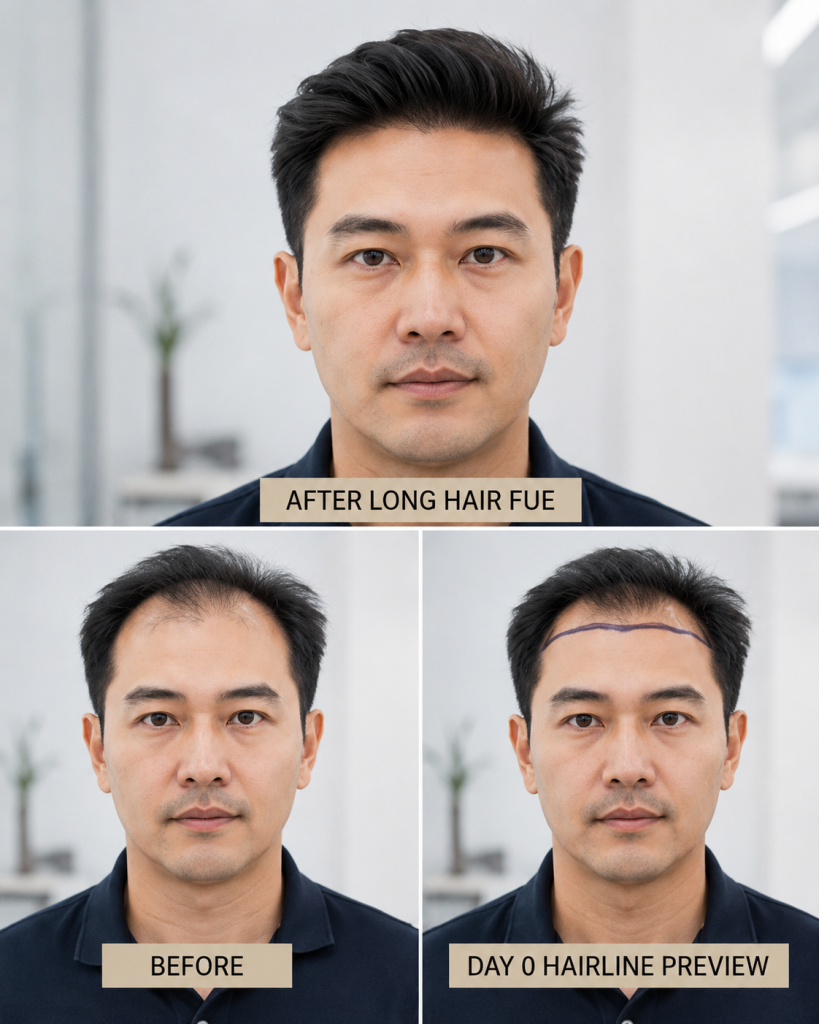
A hairline drawn for the face, not a template
Early growth is generally visible from month three. Density continues to build through months six to nine, with the full character of the result settling across roughly twelve months.
02
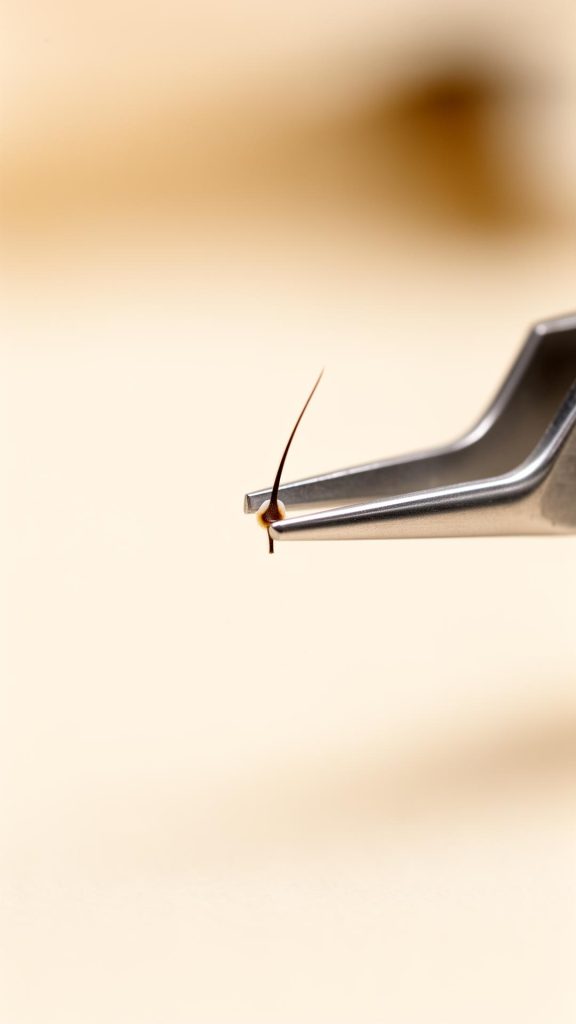
Selective extraction within preserved length
Grafts are taken individually, between full-length hairs, so the donor area reads as untouched from any angle that another person would actually see.
03
Frontal, M-shape and crown planned as one
Recession and crown thinning are addressed within a single architecture — so the result remains coherent across the whole scalp, not stitched together over time.
04
Density placed for how a man wears his hair
Direction, angle, and density are calibrated to the patient’s natural styling — short, swept, parted, or grown — so the hairline reads correctly in his actual life.
05
A plan considered across years, not weeks
Decisions account for how surrounding hair may continue to behave, so the result holds its character through the man’s forties, fifties and beyond.
06
Discretion as a clinical principle
From first conversation to final review, the experience is conducted privately, by appointment — protecting both the work and the patient.
Return to Work
A recovery the room is not asked to notice.
Healing happens within the patient’s own preserved hair. Most men return to professional life within days — without explanation, and without a visible interval to account for.
01
Day 0
The procedure ends within preserved hair. The patient leaves looking essentially as he arrived — no shaved zones, no obvious sign of treatment.
02
Days 3–7
Light professional activity resumes for most men. Calls, meetings, and travel can usually be kept on the calendar.
03
Months 3–6
Initial shedding settles quietly. New growth emerges beneath surrounding hair — often before the patient himself notices the change.
03
Month 12
The full character of the result is established — a hairline that reads as the man’s own, restored to where his face naturally sits.
Common Concerns
What we most often address in male patients.
The majority of men arrive with one — or a combination — of the following patterns. Each is approached within a single, considered architecture rather than as an isolated procedure.
01
M-shape recession
Temple recession that reshapes the upper third of the face. Restored with selective frontal density and a softened lateral line, never rebuilt as a flat wall.
02
Frontal recession
A backward drift of the hairline. Re-established at a position appropriate to age, facial proportion, and the way the man wears his hair today.
03
Crown thinning
Loss of density at the vertex — often unseen by the patient himself. Filled with attention to existing growth direction and natural whorl.
04
Density refinement
An overall thinning of the frame without dramatic recession. Reinforced selectively, beneath the visible cover, so the result reads as fullness rather than transplantation.
Hairline Education
Understanding the patterns before they're addressed.
A short, plain explanation of the four most common male presentations — what they are, how they progress, and which page on this site goes deeper into each.
Pattern 01
M-shaped recession
A symmetric retreat at the temples that leaves a central tuft and creates the M-shaped frame. Often the earliest visible change, and the one most photographed.
Pattern 02
Frontal recession
A more uniform backward drift of the entire frontal line, typically progressing slowly through a man’s thirties and forties.
Pattern 03
Crown thinning
Loss of density at the vertex, frequently unnoticed by the patient himself but among the first signs visible to a room or a camera.
Pattern 04
Executive density loss
A general thinning of the frame, without dramatic recession — common in client-facing professionals and addressed with restraint and discretion.
Frequently Asked
Direct answers.
The questions most often raised before a private assessment — answered with the same restraint as the practice itself.
01
Can I keep my work calendar through the procedure?
For most men, yes. The no-shave method is structured to leave the donor area visually intact, so meetings, travel, and on-camera work can usually continue with only a short, planned pause.
02
Will my colleagues or clients notice anything?
The procedure is designed precisely so the answer is no. Existing length conceals the working zones, and the result emerges gradually within the patient’s own framing rather than as a single visible event.
03
Can M-shape, frontal recession and crown be addressed together?
Yes. They are planned as a single architecture so the final result remains coherent across the whole scalp — rather than reading as separate procedures performed at different times.
04
How natural will the hairline look?
Naturalness is determined by hairline design and graft placement, both performed personally by Datuk Dr. Inder. The intention is a result indistinguishable from the man’s own hair, calibrated to his face and stage of life.
05
Will the result hold up as I get older?
Transplanted follicles retain their genetic resistance to thinning. The plan also accounts for how surrounding hair is likely to behave over the coming decade, so the architecture remains coherent across years rather than only months.
06
How is the consultation arranged?
Privately, by appointment. The first conversation is confidential and unhurried — followed by a personal assessment with Datuk Dr. Inder to clarify candidacy and outline what a considered plan would look like.
A direct conversation, in private.
design considerations, and what a considered plan would look like for your
face, your work, and your stage of life.
ABHRS Diplomate · ISHRS Fellow · 30+ Years Experience