The Procedure

What is Long Hair FUE?

A specialised form of follicular unit excision performed without shaving the visible hair. This page is a clear, medically grounded explanation of how the technique works, what patients can realistically expect, and how candidacy is assessed.

Long Hair FUE - iGraft Long Hair FUE

Definition

A clear, medical definition.

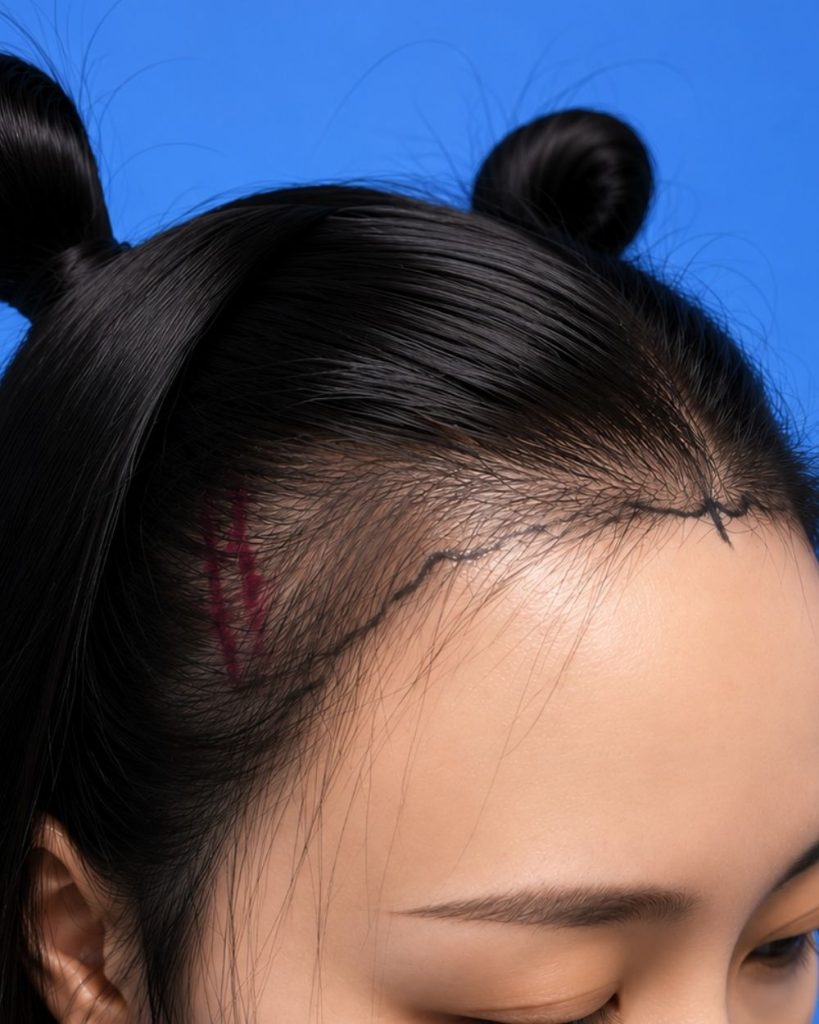
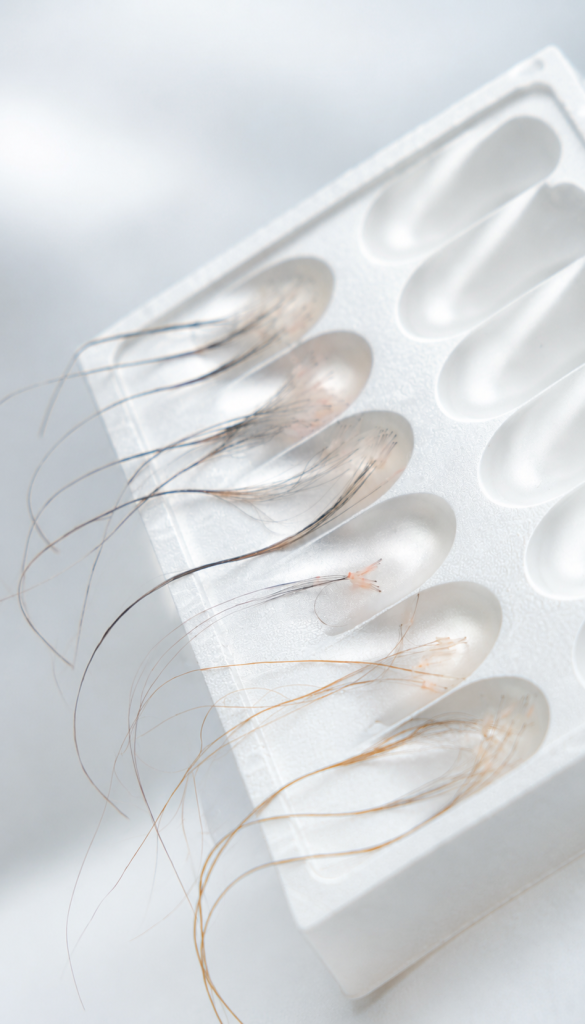
Long Hair FUE is a specialised form of follicular unit excision in which selected follicles are extracted and transplanted while the surrounding visible hair is preserved at its existing length — across both the donor and recipient zones.

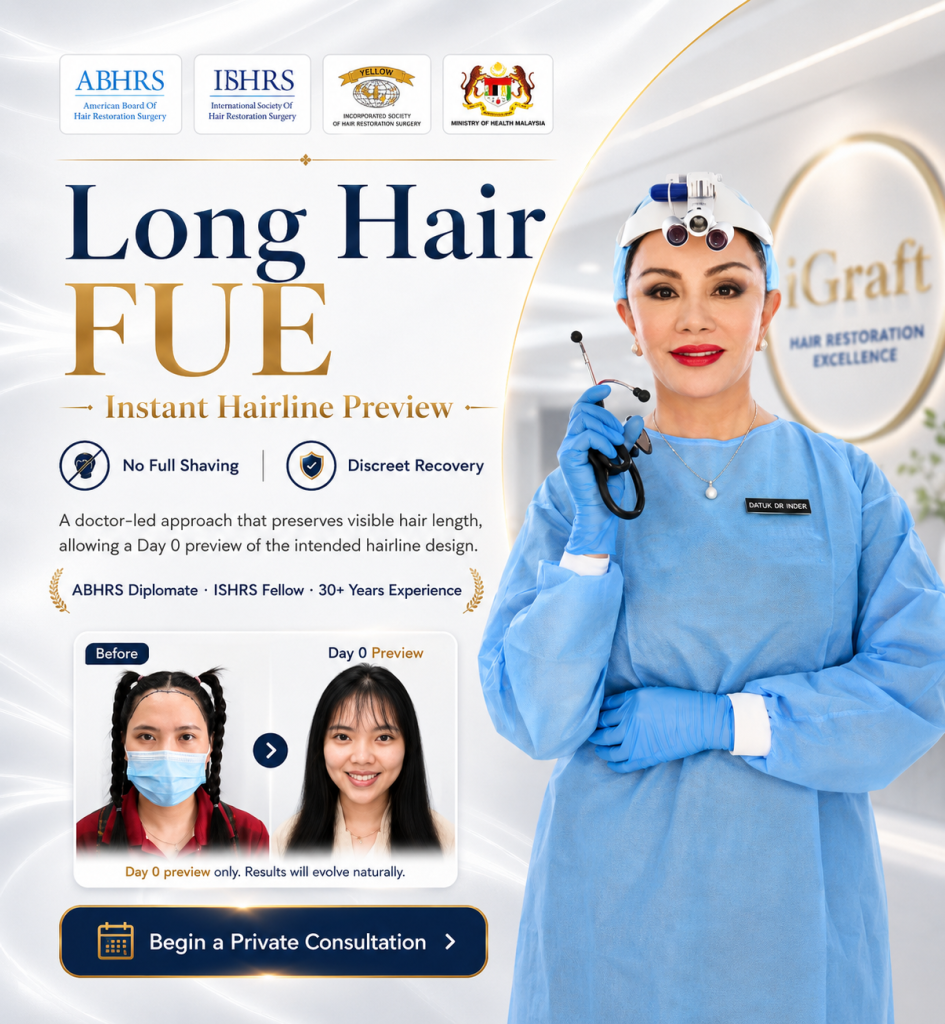
Because the transplanted hairs retain length, the intended hairline design, direction and density can be observed immediately after placement, allowing the patient and surgeon to confirm the architecture on the day of the procedure rather than waiting for regrowth to assess shape.

Long Hair FUE is a clinical refinement of FUE — not a different procedure, and not a guarantee of a different outcome.

Why Long Hair FUE is more technically demanding.

technique .  Details

within Preserved Lenght

Why It Is Demanding

Why Long Hair FUE is more technically demanding.

Working between full-length hairs imposes constraints that conventional shaved FUE does not — on visibility, on pace, and on the precision required at each stage.

01

Preserved hair-shaft management

Each follicular unit is excised with surrounding length intact, so the hair shafts must be kept clean, oriented and undisturbed throughout extraction and storage.

02

Reduced graft visibility during work

Because the donor area is not shaved, individual graft sites are partially obscured by surrounding hair — requiring slower, more deliberate selection rather than visual sweeps across an open field.b

03

Strict angle preservation

Existing growth direction must be matched exactly. Even small deviations in angle or rotation are visible against neighbouring long hairs and cannot be hidden under stubble.

04

Considered donor planning

Density is read across the entire donor zone before extraction begins, so harvesting remains evenly distributed and the area continues to read as untouched at full length.

05

Implantation precision

Recipient sites are created at depths and angles matched to each individual graft, calibrated to the patient’s natural growth pattern in the surrounding hair.

06

Slower clinical pace

Long Hair FUE is intentionally slower than conventional shaved FUE. The technique trades operative speed for visual continuity and design control.

Day 0 Preview

What the Day 0 preview actually means.

Because the transplanted hairs retain visible length at the time of placement, the intended hairline shape, position and direction can be observed immediately. This is the Day 0 preview — a visualisation of design, not a statement of final density.

In the weeks that follow, most patients experience temporary shedding of the transplanted hair shafts. This is a normal part of the follicular cycle. The follicles themselves remain in place beneath the scalp and re-enter an active growth phase across the following months.

The final result is therefore not visible on Day 0 — only the architecture of where it will arrive. Final character develops gradually across roughly twelve months as new growth integrates with the surrounding hair.
iGraft Long Hair FUE - Hair Line

Realistic Expectations

Growth, recovery, and time.

Long Hair FUE follows the same biological timeline as any hair restoration. The visual experience differs — the underlying process does not.

01

Growth takes time

Early growth is generally visible from month three. Density continues to build through months six to nine, with the full character of the result settling across roughly twelve months.

02

Recovery still matters

Although recovery is largely concealed by surrounding hair, aftercare instructions — sleep position, washing, sun exposure, physical activity — remain important to the final outcome.

03

Healing varies between individuals

Scalp sensitivity, redness, and the speed of early growth differ from patient to patient. Realistic expectations are set in consultation, based on individual hair and skin characteristics.

04

Final density depends on biology and planning

The achievable density is determined by donor quality, graft yield, recipient capacity, and the design plan agreed during consultation — not by the technique alone.

A Calm Comparison

Long Hair FUE vs. standard FUE

Both procedures share the same surgical foundation. The difference lies entirely in how the patient experiences it — before, during, and long after.

Long Hair FUE vs. standard FUE - Donor Area

Aspect

Standard FUE

Long Hair FUE

Donor preparation

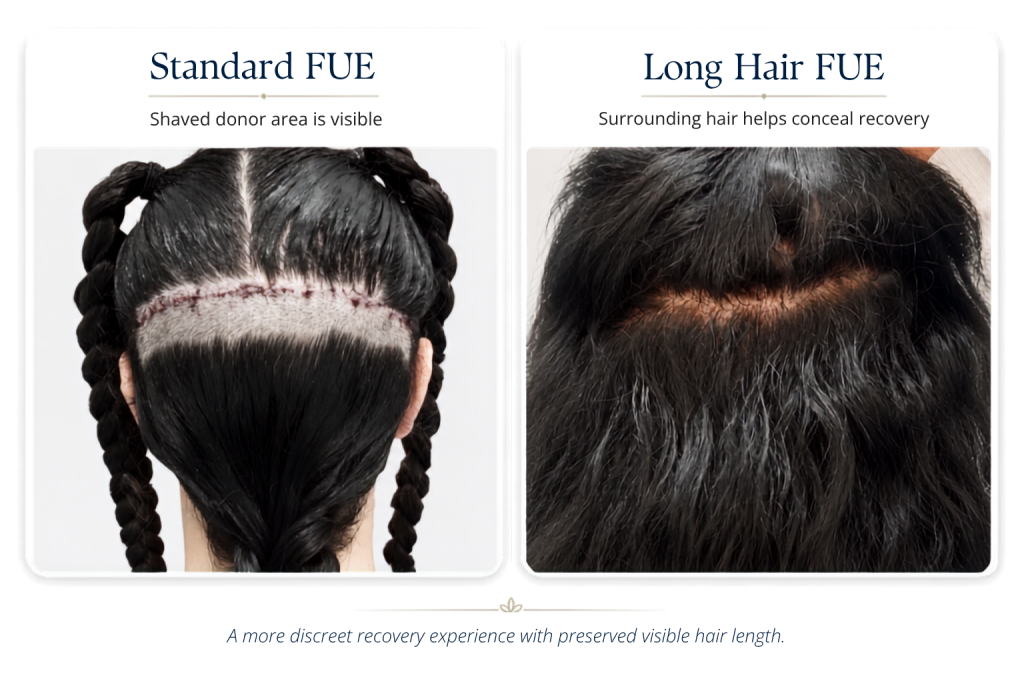
Donor area shaved to short stubble before extraction.

Donor area kept at the patient’s existing length throughout.

Visibility during recovery

Shaved zones and scabbing are visible until hair regrows.

Shaved zones and scabbing are visible until hair regrows.

Day 0 appearance

A shaved, clearly post-procedural look.

A shaved, clearly post-procedural look.

Technical complexityc

Established workflow with high visibility of graft sites.

More technically demanding — slower, more deliberate, and design-led.

Typical patient goals

Maximum graft volume in a single session, recovery time accepted.

Reduced visibility during recovery; emphasis on hairline design and naturalness

Candidacy

Who is suitable.

Long Hair FUE is most often considered by patients for whom visibility during recovery is a meaningful constraint. It is not, however, appropriate for every patient.

01

Executives & leaders

Patients whose work involves visible meetings, travel, or board-level presence and who cannot accommodate a shaved recovery period.

02

Women

For whom shaving is rarely appropriate, and for whom the donor area must remain visually intact at full length.

03

Public-facing professionals

Founders, performers, broadcasters and figures who appear regularly in photography or on camera.

04

Patients seeking reduced visibility

Those who prefer a recovery that does not advertise the procedure to colleagues, family or the wider room.

Long Hair FUE is most often considered by patients for whom visibility during recovery is a meaningful constraint. It is not, however, appropriate for every patient.

Realistic Expectations

Related pages on the technique.

Long Hair FUE follows the same biological timeline as any hair restoration. The visual experience differs — the underlying process does not.

01

How the no-shave principle is applied across the procedure.

02

The technical reasoning behind unshaven extraction and placement.

03

A closer look at how the technique is performed in clinic.

04

Application to male patterns — frontal, M-shape, crown and density.

05

Application to female hair loss, hairline lowering and density work.

Frequently Asked

Medical questions.

The questions most often raised before a private assessment — answered with the same restraint as the practice itself.

01

No. The defining principle is that the visible hair — including across the donor area — is preserved at its existing length throughout the procedure. There is no full or strip shaving.

02

No. Day 0 shows the intended hairline shape and design because transplanted hairs retain their visible length. It is a visual preview only, not the final grown-in result.

03

Yes — temporary shedding of the transplanted shafts is a normal part of the cycle and typically occurs within the first weeks. The follicles themselves remain in place and re-enter active growth in the months that follow.

04

Early growth is generally visible from around the third month. Density continues to build through months six to nine, and the full character of the result becomes apparent across roughly twelve months.

05

Yes. Working between full-length hairs reduces visibility of graft sites, requires strict angle matching, and imposes a slower, more deliberate operative pace. It is a refinement of FUE — not a shortcut to it.

06

No. Suitability depends on donor density and quality, hair characteristics, graft requirements, scalp condition and medical history. Candidacy is determined by personal assessment with the treating doctor.

07

Because surrounding hair remains at length, the working zones are largely concealed during early healing. Most patients return to their routine within days, though individual healing varies.

Understand whether Long Hair
FUE is suitable for you.

A doctor-led assessment with Datuk Dr. Inder — to review your hair, your
recovery expectations, and your long-term goals, and to clarify whether this
technique is the appropriate approach for your case.

ABHRS Diplomate · ISHRS Fellow · 30+ Years Experience