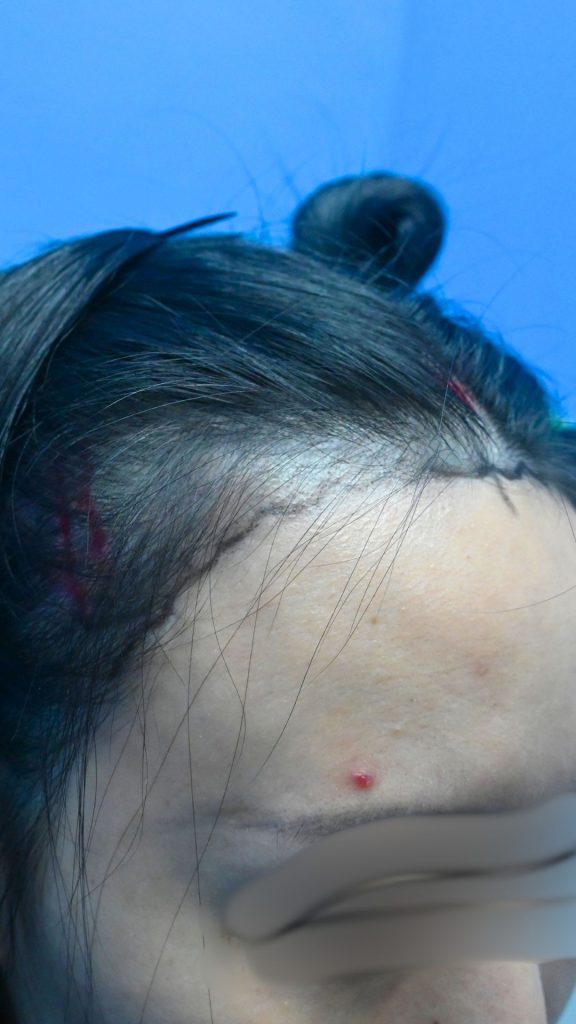
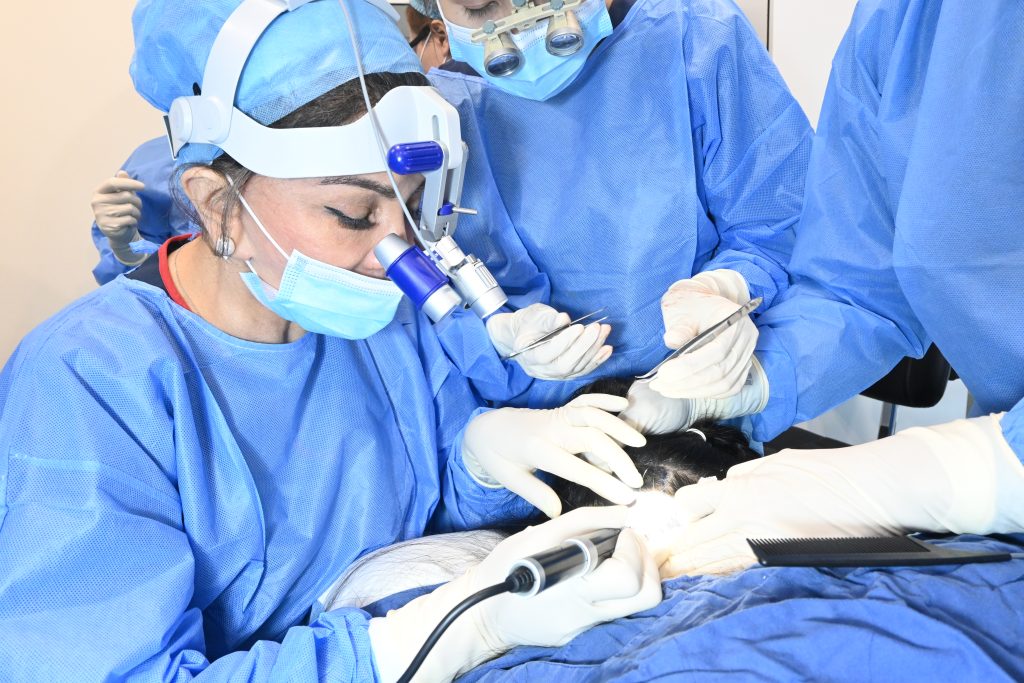
The iGraft technique is a refinement of follicular unit excision, carried out entirely within the patient’s existing hair length. It shares the same surgical foundation as standard FUE; what changes is how each stage is performed — more slowly, more deliberately, and with the design visible from the first graft. The first step is an unhurried, doctor-led conversation — not a treatment plan.
Without a shaved field, every graft is selected, handled, and placed between full-length hairs. That removes the safety net of a clear view — and demands a higher order of accuracy at each stage.
01
Graft sites partly hidden
Because the donor area is not shaved, individual sites are partially obscured by surrounding hair, so selection is slower and more deliberate.
02
Hair shafts kept intact
Each follicular unit is excised with its length intact, so the shafts must stay clean, oriented, and undisturbed through extraction and storage.
03
Angles that cannot hide
Small deviations in angle or rotation are visible against neighbouring long hairs, so the existing growth direction must be matched exactly.
04
A deliberately slower pace
The technique trades operative speed for visual continuity and design control.
In Clinic
The technique, stage by stage.
01
Design and donor planning
The hairline is drawn with the patient, and density across the whole donor zone is read before extraction begins, so harvesting stays evenly distributed.
02
Selective extraction
Each follicular unit is selected and lifted individually with calibrated micro-instruments, between full-length hairs, preserving the surrounding tissue.
03
Graft preservation
Grafts are held in a controlled environment that protects their viability between extraction and placement.
04
Precision implantation
Recipient sites are created at depths and angles matched to each graft and to the natural growth pattern of the surrounding hair.
The iGraft Approach
Design you can see, on the day.
Because transplanted hairs keep their length, the intended hairline shape, position, and direction can be seen immediately after placement. This Day 0 preview is a view of the design — not a statement of final density.
01
A Day 0 design preview
Patient and surgeon can confirm the architecture on the day, rather than waiting months for regrowth to judge the shape.
02
Natural angle planning
Angle, direction, and curl are mapped to the patient’s existing growth pattern before a single graft is set.
03
A donor area left undisturbed
Extraction is balanced across the donor zone so it continues to read as untouched at full length.
04
Tissue preservation
Every step is designed to respect skin, blood supply, and the follicles already in place.
05
Doctor-led, in private
Designed and performed personally by Datuk Dr. Inder, in a setting calibrated for complete privacy throughout.
Familiarity During Recovery
A familiar appearance, throughout the process.
The technique changes the visual experience of recovery, not the biology. Healing is largely concealed by surrounding hair, but aftercare — sleep position, washing, sun exposure, physical activity — remains important to the outcome.
01
Day 0
The procedure ends within preserved hair, with the design already visible as a preview.
02
Days 3–7
Gentle aftercare. Most patients return to their routine within days, though individual healing varies.
03
Months 3–6
Temporary shedding of transplanted shafts is normal in the early weeks. Early growth is generally visible from month three and builds through months six to nine.
04
Month 12
The full character of the result settles across roughly twelve months, and is reviewed in person.
Not every patient is suited to Long Hair FUE, and the responsible answer is often non-surgical guidance, medical referral, or a recommendation to wait and re-assess. Where the technique is appropriate, suitability tends to follow a clear set of patterns.
01
Visibility is a real constraint
Patients for whom a shaved, visible recovery is not workable — executives, public-facing professionals, and many women.
02
Preserved donor reserve
Stable density at the back and sides of the scalp, evaluated personally for calibre and long-term reliability.
03
Design over maximum volume
Patients who value hairline design and naturalness over the largest possible number of grafts in a single session.
04
Realistic expectations
Final density depends on donor quality, graft yield, and the agreed plan — not on the technique alone.
Results
Design that reads as your own hair.
Outcomes are reviewed privately and discussed only in the context of the patient’s own pattern and goals. Results vary between individuals, and no specific outcome can be promised.
Patient studies shared privately during consultation
Frequently Asked
Considered questions.
The questions most often raised before a private assessment — answered with the same restraint as the practice itself.
01
Is the iGraft technique a different procedure from FUE?
No. It is a clinical refinement of follicular unit excision and shares the same surgical foundation. The difference lies in how each stage is performed within preserved hair — not in a guaranteed difference in outcome.
02
Does it require shaving?
No. Visible hair, including across the donor area, is preserved at its existing length throughout. There is no full or strip shaving.
03
Is the Day 0 preview the final result?
No. Day 0 shows the intended hairline shape and design because transplanted hairs keep their length. The final result develops gradually as new growth integrates with the surrounding hair.
04
Will the transplanted hairs shed?
Yes. Temporary shedding of the transplanted shafts is a normal part of the follicular cycle and typically occurs within the first weeks. The follicles remain in place and re-enter growth in the months that follow.
05
Why is the technique slower than standard FUE?
Working between full-length hairs reduces the visibility of graft sites and requires strict angle matching. The slower pace is what allows design control and visual continuity.
06
Who performs the technique?
Hairline design and graft placement are performed personally by Datuk Dr. Inder. She is an ABHRS Diplomate and ISHRS Fellow with more than 30 years of practice.
A considered conversation, before any decision.
An unhurried, doctor-led assessment with Datuk Dr. Inder — to understand your hair, your recovery expectations, and whether the technique is the right approach for you.