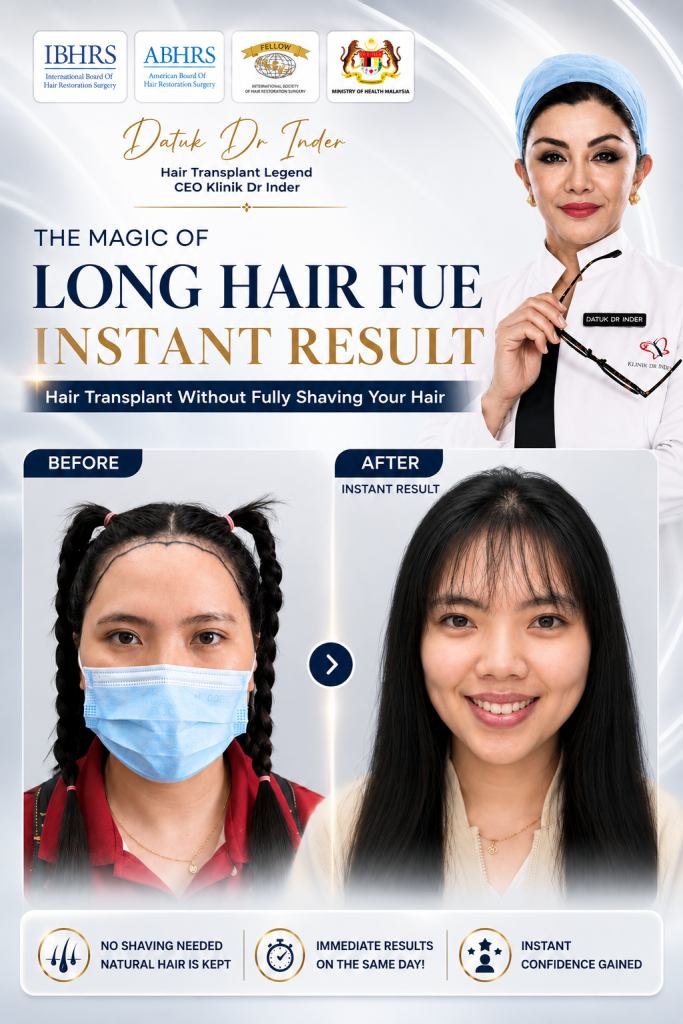
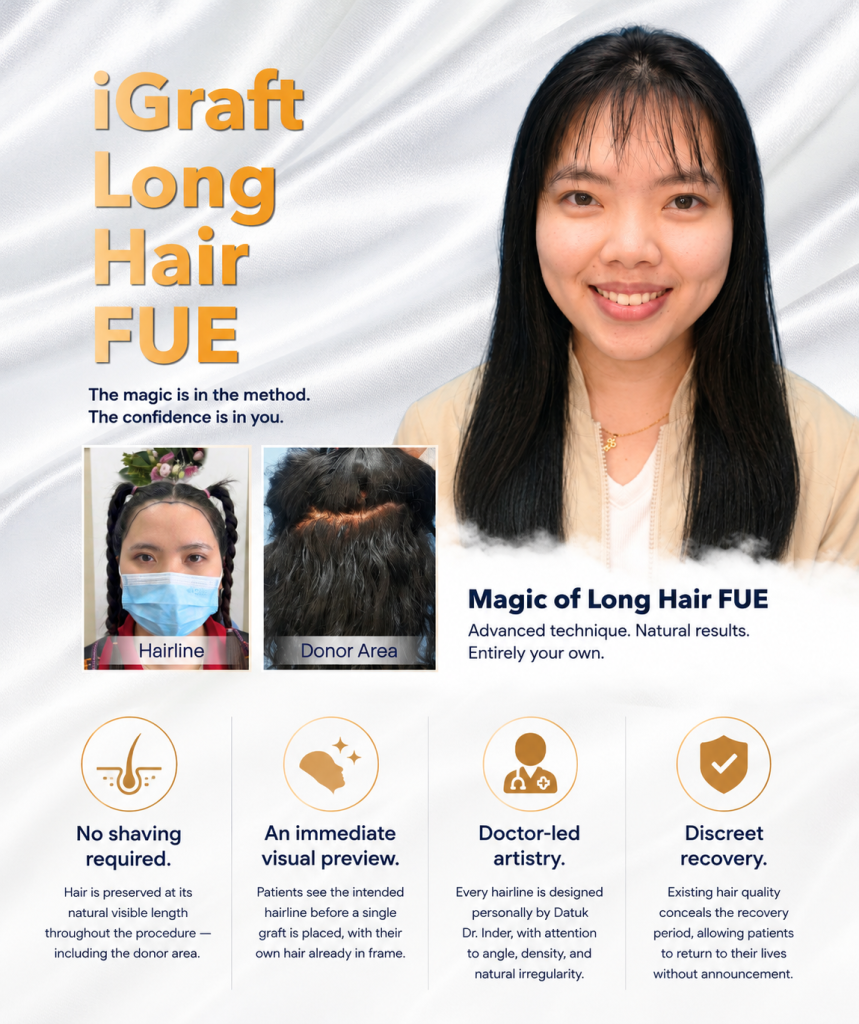
A no-shave hair transplant designed for those who cannot — and will not — disappear from public life in pursuit of a private decision. The procedure unfolds within the patient’s own preserved hair, and so does the recovery.
The decision is private. The conventional process is not.
For executives, founders, and women in public-facing roles, the visibility of a traditional transplant is rarely an option — the procedure announces itself long before the result does.
01
An exposed scalp
A fully shaved donor area, or full head, makes the choice immediately legible to colleagues, family, and the public.
02
A pause from public life
Meetings, appearances, dinners, travel — all become difficult during the weeks the scalp remains visibly altered.
03
Quiet questions
Even when nothing is said, attention is paid. The change is noticed before the result is ready to be seen.
04
An identity at stake
Hair is part of how presence is read in a room. Removing it — even briefly — is rarely a neutral act for those whose work is visible.
Why It Matters
Why traditional transplants ask too much.
The conventional approach prioritises the surgeon’s workflow over the patient’s life. For executives, public figures, and anyone whose appearance carries professional weight, that trade has always been quietly unacceptable.
01
Visibility was the standard
Concealing the procedure became the patient’s burden — caps, schedules rearranged, weeks of careful avoidance.
02
Recovery was deferred to the patient
Conventional FUE evolved around shaved donor zones because it simplified extraction — not because it served the patient’s life.
03
Discretion was treated as optional
Most clinics still treat privacy as a request to be accommodated, rather than a quality to be designed around.
04
Women were rarely considered
The conventional approach was built for a male patient willing to shave. Women were quietly told it would not work for them.
The iGraft Approach
Restoration shaped around discretion.
iGraft Long Hair FUE is the no-shave method refined into a doctor-led process — built so the procedure, the recovery, and the result remain entirely the patient’s own.
01
Preserved donor length
The donor area remains at its full visible length throughout. Existing hair conceals the working zone from the first day.
02
Selective extraction
Grafts are taken individually, with care for the surrounding hair — never by clearing the field.
03
Hairline drawn personally
Datuk Dr. Inder designs the frontal line in person, attentive to facial architecture, density, and the patient’s life.
04
An immediate visual preview
The intended result is visualised within the patient’s own hair before a single graft is placed.
05
Quiet aftercare
Aftercare is delivered with the same discretion as the procedure — privately, personally, and without intrusion.
Recovery & Visibility
The recovery no one needs to see.
Healing happens beneath the patient’s own preserved hair. Most return to professional life within days — without explanation, without announcement.
01
Day 0 — Return
The procedure concludes within preserved hair. The patient leaves looking very much like they arrived.
02
Week 1
Aftercare continues privately. Existing hair conceals the donor and recipient zones throughout the week.
03
Month 3
Initial shedding settles quietly. Public life continues uninterrupted.
04
Month 12
The full character of the result emerges — discreet, integrated, entirely the patient’s own.
Candidacy
Designed for private lives.
The no-shave approach is shaped for those whose presence is part of their work — and for whom discretion is not a preference, but a requirement.
01
Executives & founders
Patients whose calendar cannot accommodate visible recovery, and whose presence is part of how they lead.
02
Public-facing professionals
Performers, broadcasters, and figures whose visibility is part of their work and identity.
03
Women
For whom shaving is not a starting point, and for whom discretion is non-negotiable.
04
Privacy-first patients
Anyone for whom the result must arrive quietly, on their own terms.
Frequently Asked
Quiet questions.
01
Will anyone be able to tell I had a transplant?
The procedure is designed precisely so the answer is no. Existing hair conceals the working zones, and the result emerges gradually within the patient’s own framing — rarely announced, only ever noticed in the most flattering way.
02
Can I return to work the same week?
Most patients return to professional life within a few days. Aftercare is structured around the patient’s calendar — not the other way around.
03
Is this suitable for women in leadership roles?
Yes. The no-shave approach was refined with women in mind — particularly those who cannot consider any visible alteration to their hair.
04
Will the donor area look thinner?
Donor density is read carefully and balanced so that the source remains undetectable — both at the time of the procedure and as the result settles.