Temple Restoration

The frame of the face, restored softly.

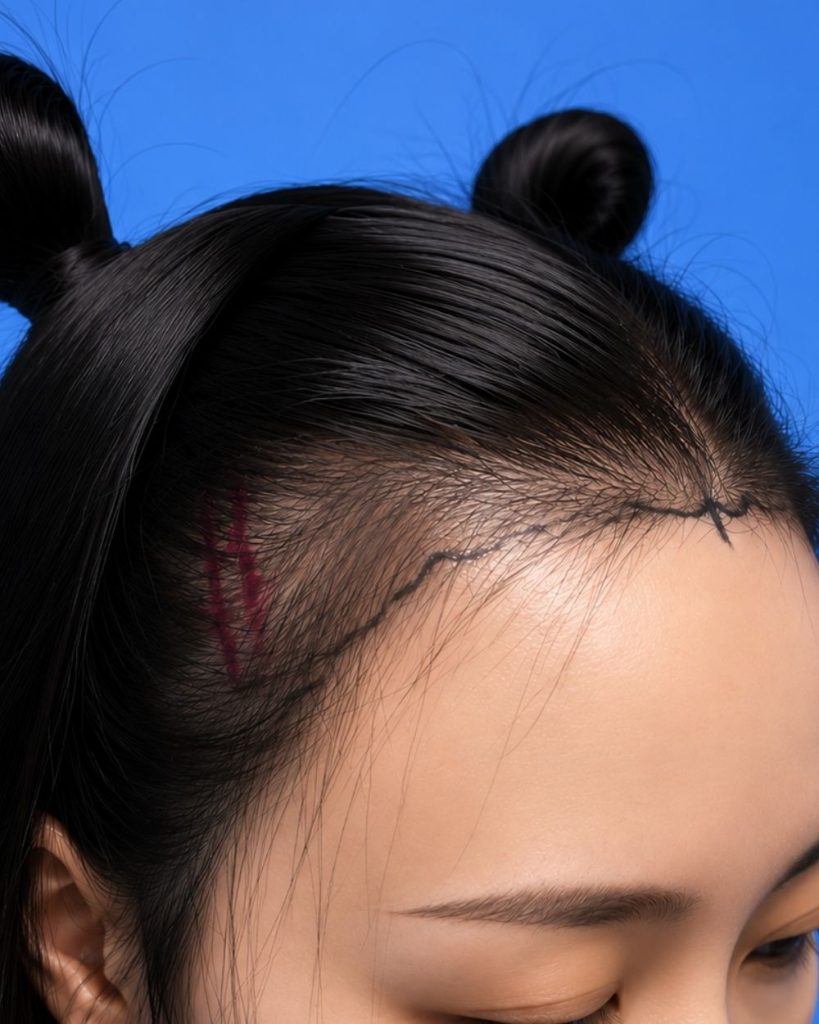
Thinning at the temples often starts subtly — noticed when hair is pulled back or tied up. Over time, it changes how the face is framed. Temple restoration with Long Hair FUE rebuilds that soft boundary between hairline and forehead, performed entirely without shaving. The first step is an unhurried, doctor-led conversation — not a treatment plan.

iGraft Long Hair FUE - Hair Line

Why It Feels Different

Why temple thinning changes how the face is framed.

The temples often open before the centre of the hairline does. The change is small in any single year, but it gradually softens the natural boundary between hairline and forehead.

01

Noticed when hair is tied back

Ponytails, updos, and pulled-back styles reveal the temples first — often before anything else is noticed.

02

A less balanced frame

As temple density reduces, the face can read less balanced and become harder to style around with confidence.

03

Photographs that read differently

Side angles and bright light often show temple thinning before the mirror at home does.

04

Styling around the gap

Many women adjust their parting or wear hair forward to cover what feels increasingly exposed.

Datuk dr Inder - Doing consultation

The Process

Four stages, one doctor throughout.

01

Private assessment

A confidential review of the temples, the frontal line, and the donor area at the back and sides of the scalp. Early review can begin remotely.

02

Temple shape drawn in person

Datuk Dr. Inder designs the temple contour directly with the patient, in relation to the frontal line and facial structure.

03

Treatment day

Grafts are extracted selectively within preserved hair and placed personally by Datuk Dr. Inder to follow the natural direction of growth at the temples.

04

Review across the year

Growth is reviewed at three, six, and twelve months, with each stage assessed in person.

The iGraft Approach

Temples and hairline, as one design.

Where restoration is the right answer, the temples and frontal line are treated as a single, continuous architecture — not as separate concerns. Density is calibrated rather than maximised, so the frame reads as soft and natural.

01

Frontal and temple together

The temple contour is designed in relation to the whole hairline, so the result remains coherent.

02

Following natural direction

Each graft is placed to blend with the existing hair and its natural direction of growth.

03

Soft, never filled

Temples are restored as a gentle transition — never as a solid block of density.

04

No shaving, at any stage

The donor area stays visually intact at full length, so styling can continue as normal.

05

Doctor-led, in private

  1. Designed and performed personally by Datuk Dr. Inder, in a setting calibrated for complete privacy throughout.


Familiarity During Recovery

A familiar appearance, throughout the process.

Where Long Hair FUE is the appropriate path, healing happens within the patient’s own preserved hair. Daily life continues with a familiar appearance — though aftercare, gentle handling, and realistic timelines remain part of the process.

01

Day 0

The procedure ends within preserved hair. The patient leaves looking essentially as she arrived.

02

Days 3–7

Gentle aftercare while surrounding hair frames the treated area. Most routines resume within a few days.

03

Months 3–6

Temporary shedding of transplanted shafts is normal. Early growth then begins to redefine the temples — gradually and at a realistic pace.

04

Month 12

The temple contour settles across roughly twelve months and is reviewed in person.

Who May Be Suitable

Not every woman with temple thinning is a surgical candidate, and the responsible answer is often non-surgical guidance, medical referral, or a recommendation to wait and re-assess. Where Long Hair FUE is appropriate, suitability tends to follow a clear set of patterns.
01

Localised temple thinning

Thinning concentrated at the temples, where surrounding density remains strong.

02

Preserved donor reserve

Stable density at the back and sides of the scalp, evaluated personally for length, calibre, and long-term reliability.

03

A clear cause

Temple thinning can have several causes, including how hair is habitually styled. Diagnosis comes before any surgical plan.

04

Realistic expectations

Women seeking a softer, more balanced frame — not maximum density.

Results

A frame that reads as her own hair.

Outcomes are reviewed privately and discussed only in the context of the patient’s own face and styling. Results vary between individuals, and no specific outcome can be promised.

Patient studies shared privately during consultation

A private clinical consultation in progress

Frequently Asked

Considered questions.

The questions most often raised before a private assessment — answered with the same restraint as the practice itself.

01

Temple thinning can have several causes, and not every type should be treated with transplantation. A personal assessment is needed to understand the cause before any plan is made.

02

No. Where Long Hair FUE is the right answer, surrounding hair is preserved at full visible length throughout. The defining principle of the method is that the patient’s own hair is not shaved.

03

They are always planned together as one continuous design. Whether both are treated in the same procedure depends on the pattern and the available donor reserve.

04

Naturalness depends on design and graft placement, both performed personally by Datuk Dr. Inder. The temples are restored as a soft transition rather than filled as a block, though individual results vary.

05

Yes. Working between full-length hairs reduces visibility of graft sites, requires strict angle matching, and imposes a slower, more deliberate operative pace. It is a refinement of FUE — not a shortcut to it.

06

Early growth is generally visible from around month three, with density building through months six to nine. The full character of the result typically settles across roughly twelve months.

A considered conversation,
before any decision.

An unhurried, doctor-led assessment with Datuk Dr. Inder
— to understand your temples, your hairline,
and whether restoration genuinely aligns with your long-term appearance.

ABHRS Diplomate · ISHRS Fellow · 30+ Years Experience