
Can Hair Transplants Be Done with Long Hair? The Truth About No-Shave FUE
For many people considering a hair transplant, the biggest concern is not the procedure itself.
It is the shave.
The thought of suddenly appearing at work, attending meetings or meeting friends with a completely shaved head can make some people postpone hair restoration for months—or even years.
But does a hair transplant really require you to shave your head?
Not always.
Advanced techniques such as Long Hair FUE and No-Shave FUE can allow suitable patients to undergo hair transplantation while maintaining much of their existing hairstyle. At Klinik Dr Inder, iGraft Long Hair FUE is designed for patients who value discretion and want to minimise the obvious visual signs associated with conventional shaved hair transplantation.
Why Is the Hair Usually Shaved for FUE?
Follicular Unit Excision, commonly known as FUE, involves individually harvesting follicular units from a donor area—usually the back and sides of the scalp—and transplanting them into areas affected by hair loss.
In standard FUE procedures, the donor hair is commonly shortened to make the follicles easier to visualise, access and extract. ISHRS clinical guidance notes that many conventional FUE procedures are performed with donor hair trimmed very short, although partial-shave, no-shave and long-hair variations also exist.
While shaving can make the surgical process more efficient, it also creates one of the most noticeable parts of the recovery period.
For someone who needs to return to work, meet clients, attend events or simply keep their hair transplant private, this can be a major concern.
What Is iGraft Long Hair FUE?
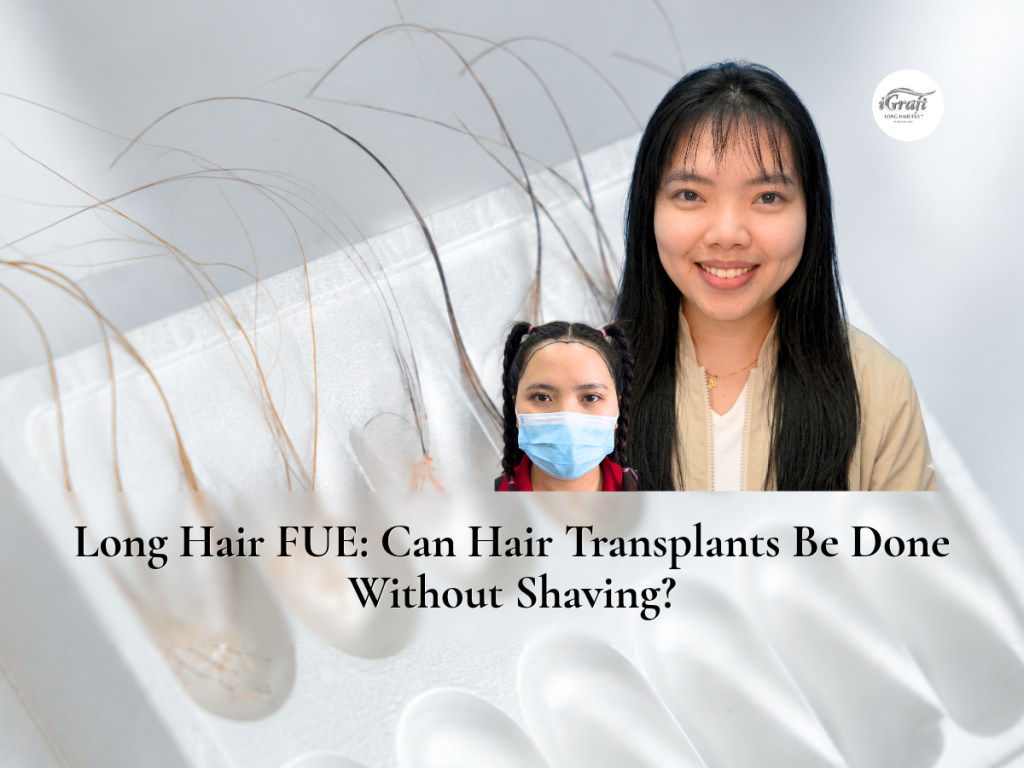
iGraft Long Hair FUE is a hair-transplant approach designed to preserve the patient’s existing hair length rather than requiring the traditional close shave associated with conventional FUE.
Long-hair FUE itself is an established variation of follicular unit excision. Recent medical literature describes long-hair FUE as a technique that can harvest follicles without shaving the donor area.
Depending on the patient’s hair, donor characteristics, degree of hair loss and surgical plan, the procedure may allow the surrounding donor and recipient hair to remain long.
This makes the treatment considerably easier to conceal after the procedure.
Instead of waiting for an obviously shaved donor area to grow back, the patient’s existing longer hair can help camouflage early redness or small healing points.
Can Hair Really Be Transplanted While It Is Long?
Yes.
However, long-hair FUE requires a high degree of technical precision.
The physician must identify suitable follicular units while working among longer surrounding hairs. The extraction process also requires careful control because rotating instruments can potentially catch or tangle adjacent hair.
ISHRS surgical guidance describes no-shave FUE as an advanced procedure and notes that special attention must be given to hair direction, adjacent hairs and follicular-unit extraction.
The natural direction and exit angle of each hair are especially important.
When the follicular units are transplanted into the recipient area, appropriate positioning and angle help create a hairline that follows the natural pattern of the surrounding hair.
This is one reason long-hair transplantation is not simply conventional FUE performed without a haircut—it is technically more demanding.
The Biggest Advantage: Discretion
For many patients, the main reason for choosing Long Hair FUE is simple:
They do not want people to know they had a hair transplant.
Longer existing hair can help camouflage the donor and recipient areas during the early healing period. Published hair-restoration literature has noted that long hair can conceal redness and crusting and can help patients return more discreetly to professional and social activities.
This can make Long Hair FUE particularly attractive for:
- Business owners and corporate professionals
- Public figures and content creators
- Doctors, lawyers and other client-facing professionals
- Women with long hair
- Individuals attending upcoming social events
- Anyone who prefers to keep their hair-transplant journey private
There may still be some temporary redness, crusting, tenderness or swelling following surgery, so “no visible shaving” should not be confused with literally having no recovery period.
But for appropriate candidates, the difference in discretion can be significant.
See Your New Hairline Immediately
Another interesting advantage of transplanting longer hair shafts is the ability to see an immediate temporary visual preview of the newly created hairline.
Because the transplanted follicles still have visible hair shafts attached, patients can get an early impression of:
- Hairline shape
- Direction
- Distribution
- General framing of the face
Long-hair transplantation has historically been described as providing a temporary preview of the potential visual appearance of the transplanted area.
However, this is important:
What you see immediately after surgery is not the final hair-transplant result.
Many transplanted hair shafts may shed during the weeks following the procedure. The follicles then enter their normal growth cycle before new hair gradually begins to emerge.
The Day-0 appearance should therefore be viewed as a visual indication of the hairline design, not a guarantee of final density or growth.
Is Long Hair FUE Better for Women?
For many women, shaving a large donor area can be one of the biggest barriers to considering hair transplantation.
Long Hair FUE may provide an alternative because existing hair can potentially remain long enough to conceal the donor area during recovery.
It may be considered for suitable female patients experiencing certain forms or patterns of hair loss, but proper diagnosis is essential before surgery.
Hair loss can have many causes, and not every type of hair loss should be treated with transplantation.
A medical assessment of the scalp, donor density, hair-loss pattern and future progression should therefore come before deciding on the procedure.
Long Hair FUE vs Traditional FUE
The fundamental goal is the same: move suitable follicular units from a donor area into an area requiring restoration.
The biggest difference is how the hair is managed during surgery.
Traditional FUE commonly involves trimming or shaving the donor hair to provide easier surgical access.
Long Hair FUE aims to preserve longer hair shafts during harvesting, allowing the surrounding hairstyle to help disguise the procedure.
The trade-off is that Long Hair FUE can be technically more demanding and may take longer to perform. Hair-restoration literature has described long-hair FUE as a challenging, slower technique requiring advanced surgical skill.
For this reason, the best technique should not be selected based only on whether you want to shave your hair.
Your doctor should also consider your:
- Donor density
- Hair calibre
- Hair texture and curl
- Degree of hair loss
- Number of grafts required
- Existing hairstyle
- Scalp condition
- Expected future hair-loss progression
Is No-Shave FUE Really Completely Scar-Free?
No.
This is another important misconception.
FUE avoids the long linear donor scar associated with strip harvesting, but each extracted follicular unit involves a small incision in the donor skin.
The ISHRS specifically notes that FUE can leave small round scars and advises against describing the technique as completely “scarless.”
When appropriately planned and performed, these tiny extraction points can often become difficult to notice—particularly when they are covered by longer surrounding hair—but every surgical procedure involves healing.
Who Is a Good Candidate for iGraft Long Hair FUE?
Long Hair FUE may be particularly attractive if your priority is maintaining discretion while undergoing hair restoration.
You may want to discuss it with your doctor if:
You cannot shave your head for work.
Professionals who regularly meet customers, colleagues or the public may prefer to maintain their normal appearance.
You want to keep your procedure private.
Existing longer hair can help camouflage the early signs of surgery.
You have long hair and do not want to lose your hairstyle.
This can be especially important for female patients or men who have maintained longer hairstyles for years.
You have upcoming professional or social commitments.
Long Hair FUE may reduce the dramatic visual change associated with completely shaved FUE.
However, not everybody is automatically suitable. The final decision depends on the quality and availability of the donor hair as well as the size and characteristics of the area requiring restoration.
Does Long Hair FUE Give Better Hair Growth?
Keeping the hair long does not automatically mean the transplanted follicles will grow better than follicles transplanted through another appropriately performed FUE technique.
The main advantages relate to discretion, visual planning and preservation of hairstyle rather than promising greater biological hair growth.
Ultimately, successful hair transplantation depends on factors such as candidate selection, donor management, graft handling, hairline planning, surgical technique and postoperative care.
Hair transplantation is a surgical procedure, and the ISHRS states that surgical elements such as donor harvesting, hairline design and recipient-site creation require appropriately trained and licensed medical professionals in accordance with local regulations.
Hair Transplant Without the Shaved-Head Look
For years, patients often assumed that getting a hair transplant meant accepting weeks of an obviously shaved appearance.
That is no longer the only option.
For suitable candidates, iGraft Long Hair FUE offers a more discreet approach to hair transplantation, allowing existing longer hair to help camouflage the donor and recipient areas while providing an immediate temporary view of the newly designed hairline.
It can be especially valuable for women, professionals, public-facing individuals and anyone who wants their hair-restoration journey to remain more private.
The most important question, however, is not simply:
“Can I have a hair transplant without shaving?”
It is:
“Which hair-transplant technique is most appropriate for my hair loss, donor area and long-term goals?”
A detailed consultation and scalp assessment can determine whether iGraft Long Hair FUE is suitable for you.
Considering iGraft Long Hair FUE?
Discover whether you can restore your hair without dramatically changing your existing hairstyle.
Book a consultation with Klinik Dr Inder for a personalised hair and scalp assessment and find out whether iGraft Long Hair FUE is suitable for your hair-loss pattern.
When reading is no longer enough,
a quiet conversation follows.
ABHRS Diplomate · ISHRS Fellow · 30+ Years Experience